
P1. Parents, are you ready?
So much of "P1 readiness" has become a checklist for children: can they read, count, write, sit still, insert technical skill here. There are camps, talks, enrichment classes, and entire preschool curriculums promising your child will glide into primary school without any strife. But as parents, have we asked ourselves a harder question: are we ready? Are these packed schedules actually equipping our children for a world that is changing faster than any generation before them has known?
Much of our haste comes from love, and from fear. We want to spare our children the pain of "too late" or "I told you so." We were taught to work hard, get a stable job, raise a family, repeat. We were rarely taught to slow down, let alone pause and ask why.
Having privately tutored more than 100 children, from age 3 to 18, over a decade with a niche in the PSLE, I've journeyed with a lot of little (and not-so-little) human beings. Some came to me with AL1/2 scores, dimming across their landmark P6 year, worn down by the belief that they would "never be good enough," and ended up with a lower score than anyone expected. Others came to me failing English and emerged triumphantly with an AL1/2, in that same nine-month span. Every child had the same access to care and resource, the same pace-setting, the same guidance. Some soared the moment they felt safe. Others, despite similar conditions, crumbled under fear of failure, or quietly rebelled against expectations that never let up. Despite every parents’ best intentions, the best “foundations”, optimising every area for success, why then the differing trajectories? Deep down I knew the answer, and yet I chose to ignore it.
Then in 2020, I became a mother. Over the last six years, watching my own daughter move through her preschool years, I've caught myself asking her, more often than I'd like to admit, "Why would you do that?" "Why did you think that was a good idea?" Usually out of my own frustration, rarely to her benefit. So much of my parenting was coming from a place of fear: that she might not be "good enough," or even that she wasn't "normal." Then, the switch flipped.
In 2024, we went through a complicated, life-altering late miscarriage with our second child. This happened while I was climbing rapidly in a corporate career. The pause that grief forced on me changed how I saw life, and how I saw children. It stripped away the illusion of control parents carry, the sense that so much rests in our hands when, truly, it doesn't. Before that, I'd been driven by fear of the future, shaped by the shadow of my own childhood. In the name of love, I wanted to prepare her for everything. That season made me question what actually mattered, and I found I'd had the answer all along: Children don't thrive on mere preparation, they thrive on safety and belief.
Beginning with the end in mind.
If we begin with the "end" in mind, the PSLE is the literal end of primary education. And yet, as grown-ups, haven't we all seen that the PSLE is just one of countless checkpoints we face across a lifetime? My husband and I are proof of it. I scored well enough to get into the top co-ed school, and despite entering the school at the top 15% of the cohort, I finished among the lowest 5% of my cohort at O levels. My husband did worse than expected at PSLE and turned it around spectacularly at the O levels. We both ended up at similar universities and took wildly different career paths since. What carried us through was the resilience our families gave us room to grow, in environments that felt safe enough to fail in.
Someone might argue it's connections that take you far, and that the "right" primary school sets that up. Maybe. But connections are only as good as what you do with them: whether you can hold a conversation, contribute in thought and in deed, tell right from wrong. A child with every connection in the world and none of that can still be stuck.
As a recovering tiger mum, I now know there's no 10-year series, no fixed formula for "success." Childhood optimisation is a fallacy, sold to well-meaning parents. Even if the child is “successful”, may I curiously then question, at what cost?
So when I was asked by the Straits Times, amid the recent changes to the P1 registration scheme, why we chose the school we did for my own daughter, I answered plainly: proximity. I wanted the gift of everyday hellos and goodbyes, connection over commute. That's the same question we hear constantly on our school tours: How does an environment like ours actually build P1 readiness? Our programmes are thoughtful and expansive, but what drives them comes down to three things.
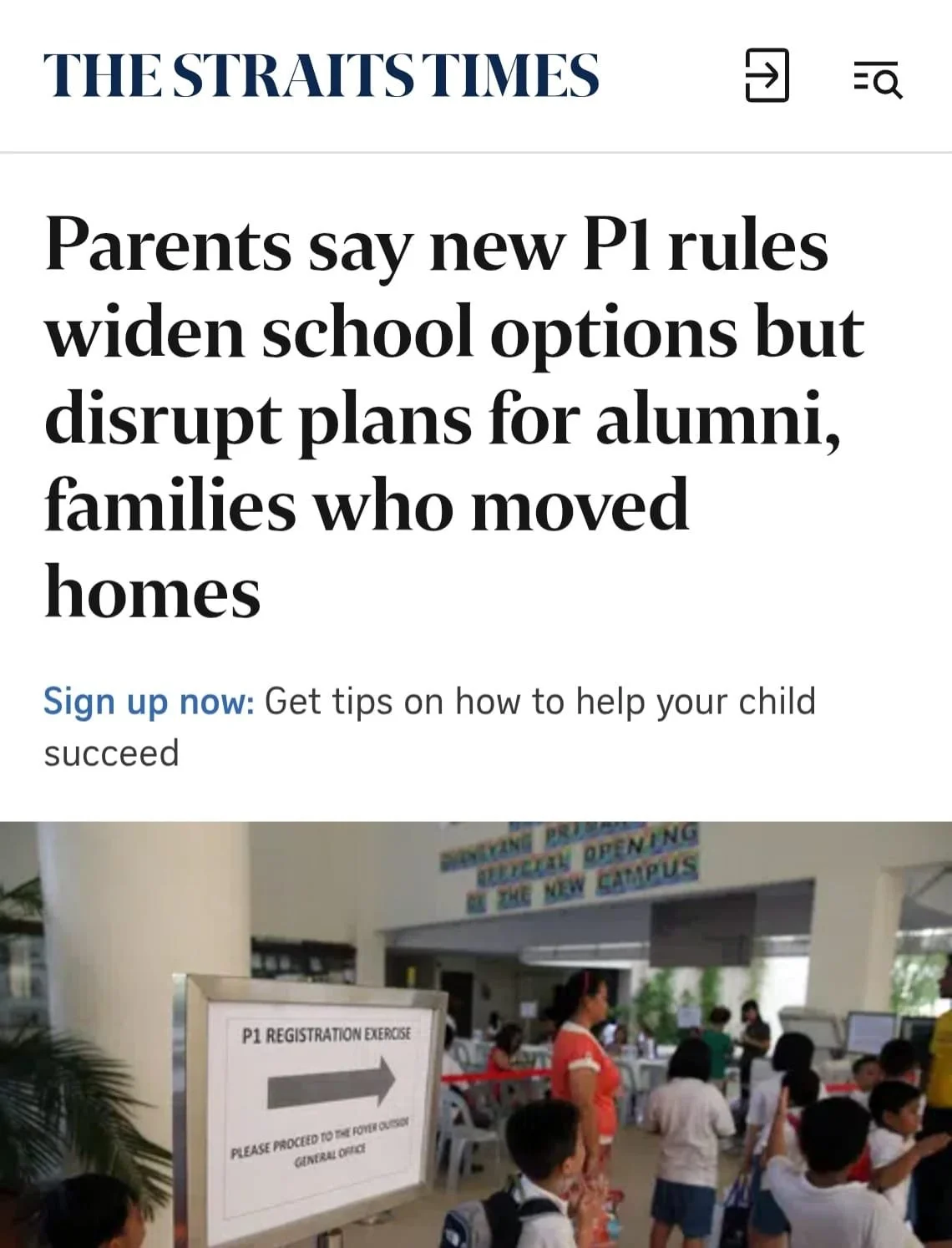
“The question is, what is the purpose of education. The teachers and schools do play a huge role in educating children, but so much of it also lies on the families,”
Jasmine Lin, in Straits Times article “Parents say new P1 rules widen school options but disrupt plans for alumni, families who moved homes”
1. Safety and security: the real roots of development
Attachment theory starts from a simple premise: a child's nervous system is built to seek closeness with a trusted adult before it can do anything else well. Psychiatrist Dan Siegel, who coined the term "window of tolerance," describes this as the zone in which a child can stay calm, think clearly, and take in new information. Step outside that window, into overwhelm or shutdown, and learning simply isn't available, no matter how well a lesson is designed. Siegel is also clear that no parent or teacher gets this right all the time. What builds real security is the repair that follows a rupture: a teacher who kneels down after a hard moment and reconnects, a parent who comes back after losing their patience and says so.
Physician Gabor Maté, writing with developmental psychologist Gordon Neufeld, makes a related point from a different angle: attachment is a child's first priority, ahead of learning, ahead of behaving well, ahead of everything else. Their metaphor is a plant. A seed needs roots before it can grow toward the sun. A child needs to feel held by at least one steady adult before they're free to turn their attention outward, toward curiosity, friendships, and new challenges. This is why the relationship a child builds with a preschool teacher matters so much. Maté calls this a "secondary attachment": an anchor adult outside the family a child can depend on when a parent isn't there.
Well before P1, this looks like small, ordinary things: a child who gets upset can be comforted, and does return to calm. A child who makes a mistake looks toward an adult, not away from one. A child moving into a new environment, like a P1 classroom, does better when they've had practice trusting that adults will notice and help them. Not because they've memorised more facts, but because their nervous system has learned that people can be relied on.
With every yes, what are we saying no to? Have we slowed down enough to connect with our children, so the structure and boundaries we set are held inside real warmth? Are we relationship-first, or outcome-first?
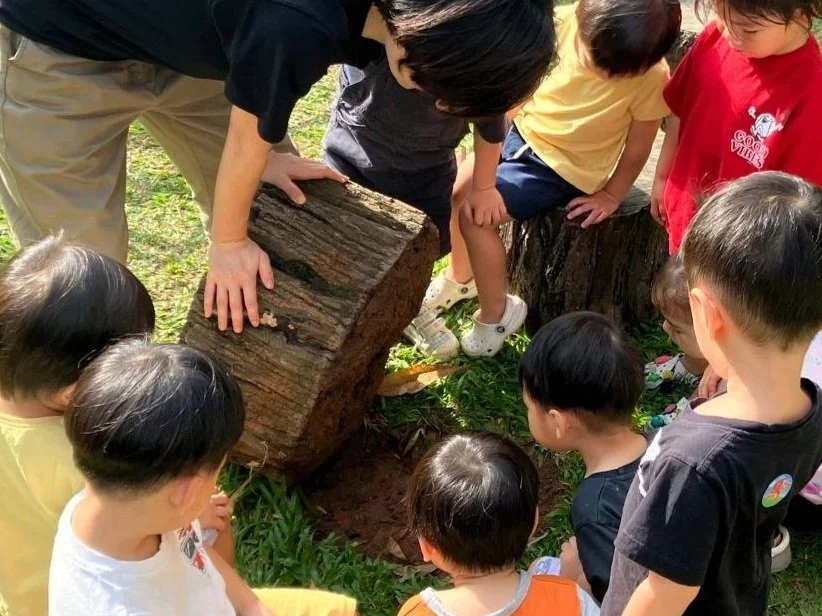
Children at Wonder Yard Schoolhouse observing creepy crawlies under a log in the garden
2. Resilience and compassion: soft and strong
Here is the statistic that confirmed everything I'd seen across a decade of tutoring, and more: in Singapore, one 10-to-19-year-old dies by suicide every 10 days.
Let that sit for a moment.
How have we all contributed to this?
An endless chase of ROI, even in childhood.
Enrichment classes justified with "My child seems to enjoy it, and they're learning!"
The question we ask is: When they stop looking forward to it, will you stop?
I don't deny that children sometimes need to go through hard things for their own good. Unease and discomfort are part of growth. But to what degree, and for whose benefit? Is it age-appropriate, or is it chasing a short-term gain in confidence or assurance we've been sold?
Resilience gets talked about as toughness: pushing through, not giving up, not crying. But that's not what the research describes. Siegel's window of tolerance is dynamic. It widens over time, and repeated, supported experiences of being knocked off balance and finding the way back are what widen it, not hardship alone. Psychiatrist Daniel Amen, who has spent decades studying brain development through imaging, makes a related point: a young child's prefrontal cortex, the part of the brain responsible for impulse control, planning, and emotional regulation, is still under active construction. It develops through repetition and relationship, not willpower. A child falling apart over something small isn't being weak. Their brain is doing exactly what a developing brain does.
Compassion is what resilience is built out of. A child met with warmth after a setback learns to offer themselves that same warmth later. A child only ever told to "be brave" or "stop crying" learns to hide the wobble instead of working through it. Think villain origin stories in the movies, it is said art imitates life, no?
This echoes something the educator Charlotte Mason wrote, well before any of this could be seen on a brain scan. Her first principle was that children are born persons, whole from the start. Not a set of parts, a body to be exercised, a mind to be filled, a will to be broken in, developed one at a time, in sequence. A child's feelings, her stubbornness, her curiosity, her body, are all one person, and they need to be treated as one person, including in how a hard moment is handled. When a child falls apart, it isn't "the emotional part" malfunctioning while "the smart part" stays fine. It's a whole child having a whole, reasonable response to something hard, and compassion is what lets the rest of them stay intact while it passes.
Compassion doesn't stop at the child, either. It reaches outward, and one of the steadiest ways it grows is through unhurried time outdoors, exactly the kind of time a childhood-optimisation schedule squeezes out first. Mason's own tradition of nature study wasn't really about teaching plant names. It was daily, unstructured time spent noticing living things closely: an ant carrying something too big for it, a plant that wilted overnight, a bird returning to the same branch. Children given that kind of time regularly build a quieter, more patient attention, and something that looks a lot like care: for a snail they don't want stepped on, for a tree they've watched grow, for a friend having as hard a day as the wilting plant did. Compassion for the world and compassion for oneself draw on the same muscle. A child gets gentler with themselves partly by practising gentleness with things smaller and slower than they are. Give a child time to notice, and care tends to follow on its own.
None of the stages below are a checklist. They're a direction of travel, and it moves fastest in children who've had many small, unhurried experiences of being supported through a hard moment rather than rushed past it.
At 3, resilience shoots up in tiny sprouts. A block tower falls, the child cries, is comforted, and tries again minutes later. The repair is mostly external: an adult naming what happened and staying close.
At 4, resilience has a thickened stem. A child can sit with frustration a little longer before seeking help, and starts to have words for what they feel ("I'm angry my tower fell") instead of only the tantrum. Self-compassion starts here too, in small, modelled moments: an adult saying "that was hard, let's try again" rather than "you should have been more careful."
At 5, a sore-loser moment now and then is normal. A child can lose a game without it wrecking the afternoon; or falls apart, sometimes spectacularly, but recovers with a bit of support. Early self-talk emerges: "it's okay, I'll get it next time." Where does that self-talk come from? Us. We're their first, guiding voice.
At 6, a child can be corrected without feeling like it's a verdict on who they are. They can ask for help without treating the need for help as failure. Often, they start extending that same compassion outward, noticing a struggling classmate and offering a hand, self-initiated.
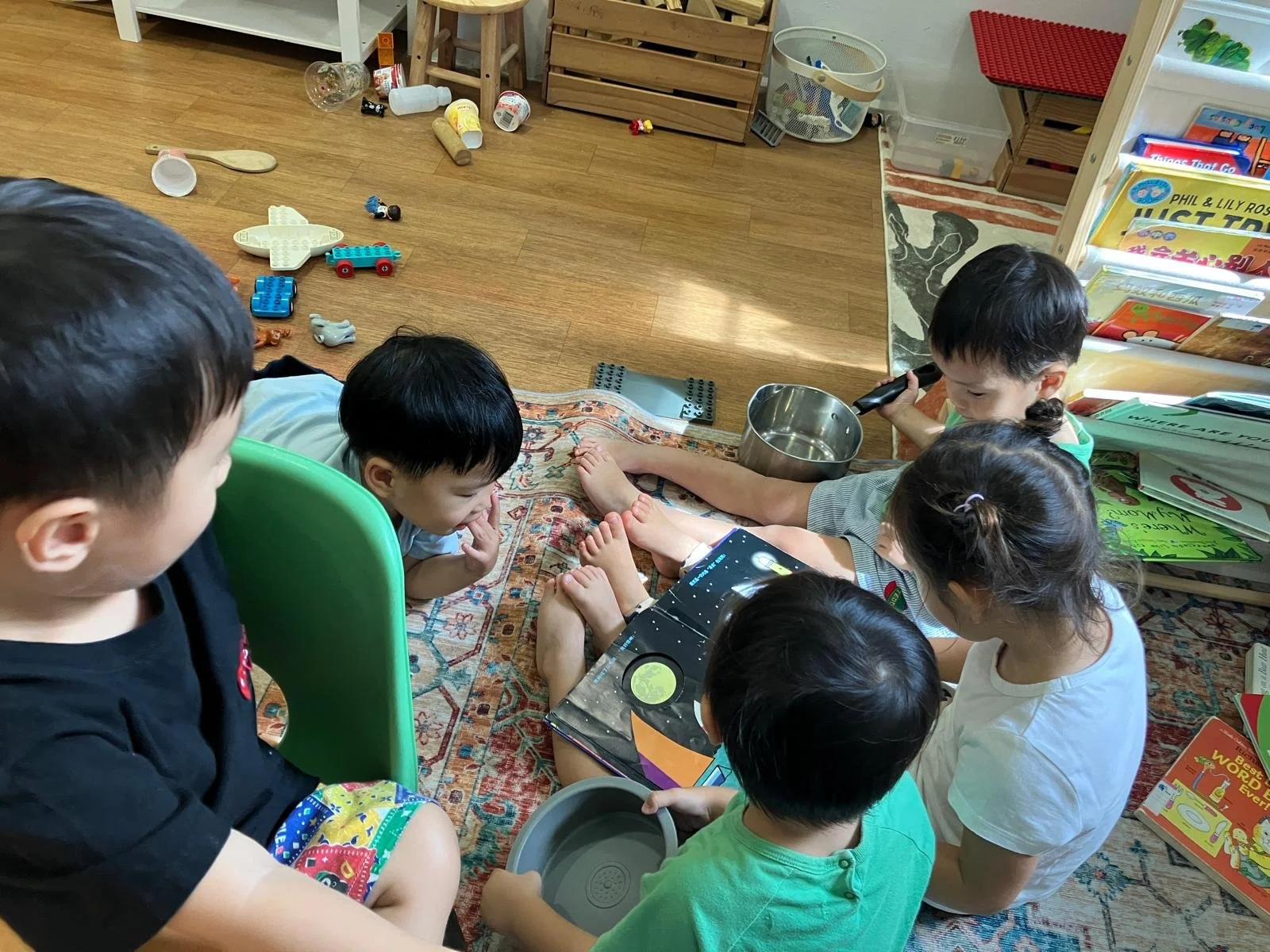
N1 class children at Wonder Yard Schoolhouse reading together
3. Self-knowledge and executive function
Executive function is the set of mental skills that let a child hold an instruction in mind, resist an impulse, and shift between tasks. A P1 classroom demands this constantly, from following a two-step instruction to the very ordinary, very demanding chain of:
Going to the canteen
Choosing which stall to order from
Queuing to order
Bringing the food to a chosen seat
Finishing the food
Returning the plate
Returning to class
Fitting in any other play, bookshop visits, library runs or toileting needs
All within 30 minutes. That may not sound difficult to an adult, but for a 6- or 7-year-old, especially one with learning differences, it's a genuinely learned skill.
Research using brain-imaging methods on preschool-aged children shows these skills develop rapidly and unevenly between ages four and seven, with a huge burst between ages 3-5. That's part of why two children born months apart can look so different in a classroom.
Self-knowledge is the quieter half of this. It's a child starting to notice their own patterns: what helps them calm down, what kind of task they find hard, when they need a break versus when they need encouragement to push through. A child with some self-knowledge can say "I need space." instead of melting down, or "Can you show me again?" instead of pretending to understand. That's not a small thing to carry into a bigger, faster-paced environment. It cannot be hurried into existence, it has to be given room to grow.
Singapore's own Ministry of Education framework for preschool, Nurturing Early Learners, is worth noting here too. It puts values, social-emotional competencies, and learning dispositions at the centre of school readiness, ahead of the five academic learning areas, on the reasoning that these dispositions are what let a child actually make use of literacy and numeracy once they're in a formal setting. Even our own education system starts from the child underneath the curriculum, not the curriculum itself.
So how now, brown cow?
Perhaps, instead of asking what a primary school can bring us, whether it's help and assistance, affiliation points at the PSLE, or protection from the fear of "insufficient rigour", we could ask a different question as parents:
What kind of humans do we want to raise?
What kind of lives would actually fill your cups, and ours?
Rather than a school decal on the car windscreen, let the evidence of a well-lived life show up in our everyday moments with our children.
We can't promise a guaranteed academic outcome. Nobody honestly can. What we can do is model, as a village, what it looks like to raise children who are resilient because they were held safely first, especially during challenges, not because they were pushed hardest with no support and only strife.
Every day at Wonder Yard, with educators who are the trusted third persons in the little lives of the children, we work to give them back a childhood. Every decision is built on growing safety, resilience, compassion, and self-knowledge, so that whatever comes after, PSLE included, children meet it as themselves, intact. We work closely with parents to build these three foundations together, because the true north for any child isn't a curriculum. It's their parents. We may not be able to shield our children from every systemic pressure out there, but we can choose, deliberately, what we prioritise and why.
If reclaiming childhood is something you believe in too, we'd love to show you what that looks like in practice. Come for a school tour, experience steady secondary attachment, see for yourself an authentic day at Wonder Yard. We'd love to meet you and your family.Jasmine Lin is a co-founder of Wonder Yard Schoolhouse. She is a recovering tiger mum and a tutor with more than a decade of experience teaching little humans from 3 up to undergraduates, with a specialisation in the PSLE.
