
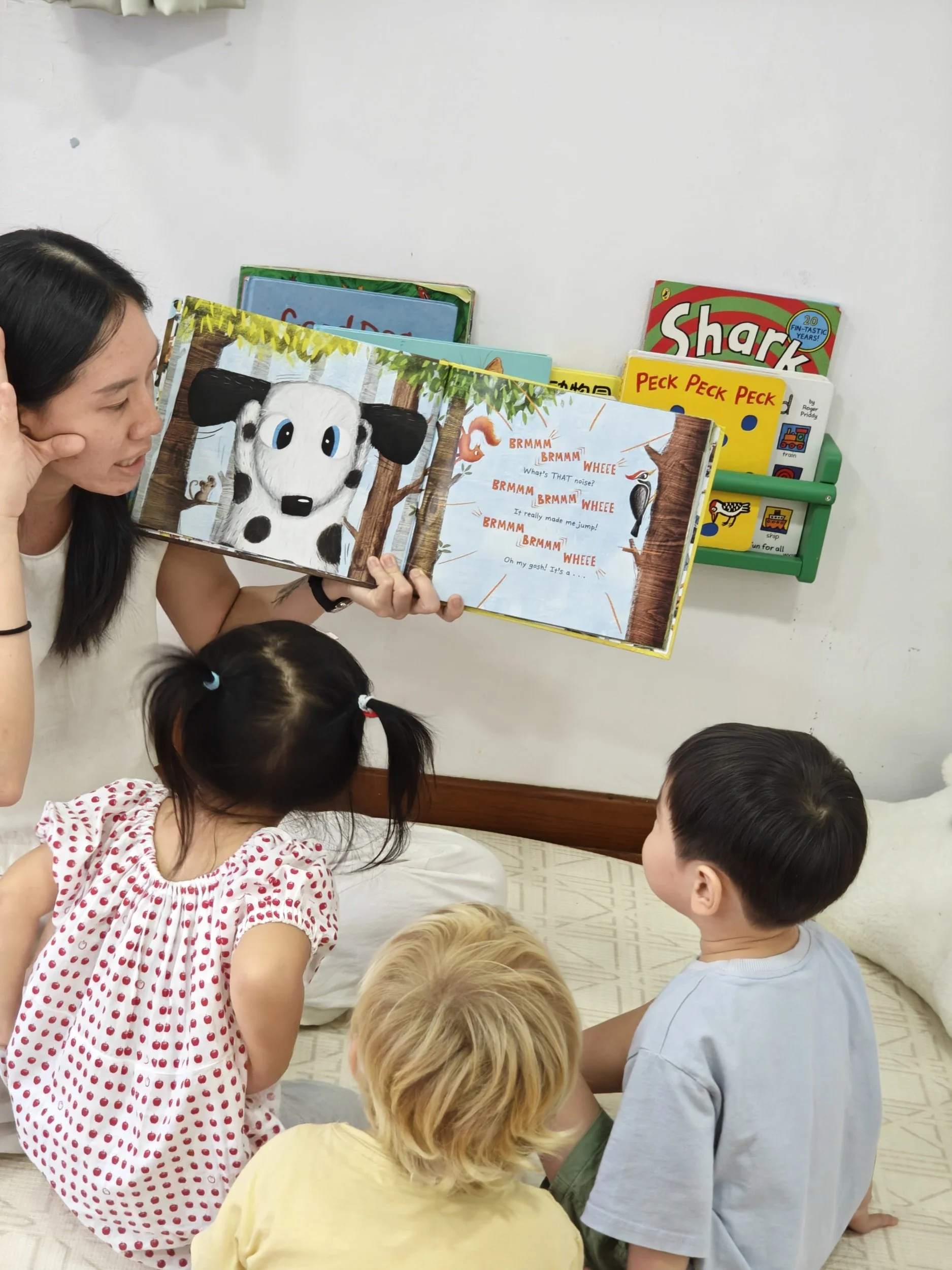
Every book our children have loved, fought over, and re-read 10,000 times, plus exactly how to use each one at home.
At Wonder Yard Schoolhouse, our Little Critics Club puts every new library book through the toughest review process in early childhood education: a room full of children aged 1.5 to 6, with no filter and strong opinions. This list collects every title from Issues #1–4, their verbatim reviews, and most importantly, the questions that turn a bedtime story into a real conversation with your child.
Because the goal was never just to raise readers. It's to raise children who feel safe, regulated and connected in relationship.
English books
Feelings and Big Emotions
-
By Jory John & Pete Oswald
The story: A sunflower seed with a scary reputation (he cuts in line, never washes his hands, lies about pointless stuff) tells you himself how he got so bad, and why he's decided to try being good. One day at a time.
What it develops: Emotional granularity — the ability to see that people (and selves) are never all good or all bad. A gentle entry into empathy, second chances, and talking about behaviour without shame.
The Little Critics said:
We asked if he's a good seed or a bad seed. Every child shouted "BAAAAAAD!" — and the review was delivered entirely in angry faces, then belly clutching giggles.
Rating: 😡😡😡😡😡 (angry faces = highest praise)Read it together:
Ask: "Do you think he's really bad… or did bad things happen to him?"
Ask: "Can someone be a little bit bad AND a little bit good?"
Don't correct their answer. You’ll learn how your child sees people.
-
By Suzanne Lang
The story: Jim Panzee is grumpy. Everyone has advice. None of it is wanted. A compact, hilarious defence of being allowed to feel your feelings.
What it develops: Permission to feel. The book never insists Jim cheer up, which teaches children that prickly, uncomfortable emotions are allowed, named, and survivable. The best way through any emotion is through it.
The Little Critics said:
O. reviewed this book entirely in monkey faces.
Rating: 🐵🙈🙉🐵🙊
— O., K1 ClassRead it together:
Ask: "What does YOUR grumpy face look like? Show me." (Then show yours. This matters.)
Ask: "When you feel grumpy, what helps — or do you just want to be grumpy for a while?"
Listen for whether your child wants solutions or space. It's different for every kid.
-
Randall de Sève & Kate Gardiner
The story: A bear cub wants the plum at the top of the tree. The branch breaks. Everyone falls — and everyone gets back up. A gentle, funny meditation on failing and trying again.
What it develops: Resilience and fear-of-failure tolerance. Normalises stumbling as part of learning — perfect for children starting hard things: a monkey bar, a new word, a first friendship.
The Little Critics said:
"So funny when the bear falls down." — the review, in full.
Rating: 🪵🪵🪵🪵🪵
— Lin., N2 ClassRead it together:
Ask: "When did YOU fall down, literally or in your feelings?"
Ask: "What's something you're scared to try because you might fall?"
Share one of your own failures first. Children often open up to parents who go first.
-
Giles Andreae & Guy Parker-Rees
The story: Gerald the giraffe can't dance like the other animals, until he finds his own music. The galloping rhymes make it irresistible to read aloud.
What it develops: Self-confidence and the gentlest introduction to the huge idea: different isn't worse. Also phonological awareness, with book’s the rhyme scheme gets children anticipating sounds.
The Little Critics said:
C.'s review is a dance. It goes like thiiiiissss. You had to be there.
Rating: 🪵🪵🪵🪵🪵
— C., N1 ClassRead it together:
Ask: "What's YOUR music? What's something you do your own way?"
Ask: "Was it kind when the animals laughed? What could they have said instead?"
Then get up and dance badly together. This is non-negotiable
-
Tanya Valentine & Jorge Martin
The story: Little Taco Truck has the perfect spot. Until bigger, louder food trucks muscle in. A story about finding your place when everyone seems bigger than you. Something our Playgroup critics know a little about.
What it develops: Vocabulary around belonging (left out, brave, welcome) and advocacy: small voices learning to say "I was here." (Warning: it will make everyone hungry. We ended up having a taco party.)
The Little Critics said:
"Read this one" x 10000 times.
Rating: 🪵🪵🪵🪵🪵
— E., 2.5, Playgroup ClassRead it together:
Ask: "Has anyone ever taken your spot? What did you do?"
Ask: "What could Little Taco Truck say to the big trucks? Let's practice."
Repeat reads are the point at this age. Each re-read, let them "read" a page to you.
-
Illustrated by Mike Gordon
The story: The classic: an emperor, two swindlers, an invisible suit, and one child who says what everyone else won't.
What it develops: The courage to speak up when something doesn't feel right. The giggles about the naked emperor also open a natural, age-appropriate conversation about bodies, privacy, and safety. The best lessons often arrive disguised as a funny story.
The Little Critics said:
"The naked book!!" "He's naked hahahaha!" "Where's his clothes?! Hehehehee"
Rating: 🪵🪵🪵🪵🪵 (unanimous)
— N2 & K1 ClassesRead it together:
Ask: "Why did only the child say the truth?"
Ask: "What would YOU do if everyone was pretending?"
And naturally: "Which parts of our bodies are private? Who's allowed to see them?" . Let the giggle carry the safety talk.
-
By Daniel G. Amen, illustrated by Brendan Kearney
The story: A group of children set up a car wash to earn money for a puppy. Things go wrong and the familiar negative self talk starts: “nobody wants us, my sign looks terrible, it’s all your fault, we’ll never get our puppy.” Enter Captain Snout, a caped hero who explains that these are ANTs (Automatic Negative Thoughts) and hands the children two Super Power Questions to squash them: Is that true? Are you 100% sure it’s true?
What it develops: Metacognition, the ability to notice a thought and treat it as something you can check rather than a fact you must obey. The author is a child psychiatrist, and the book is a picture-book version of a core cognitive-behavioural therapy technique. It names five sneaky ANTs (the All-or-Nothing ANT, the Just-the-Bad ANT, the Fortune Teller, the Mind Reader and the Blaming ANT), which gives children a vocabulary for patterns many adults still can’t spot in themselves. Pairs beautifully with This is a Sea Cow: there we fact-check a report, here we fact-check our own heads.
The Little Critics said:
"IS IT TRUE IS IT 100% TRUE??!!”
- B., 6 years oldRead it together:
Ask: “Which ANT visits YOU the most? Which one visits me?” (Be ready to be told you’re a Blaming ANT.)
Next time your child says “I’ll NEVER be able to do it,” skip the reassurance and ask the Super Power Questions instead.
The questions are for the thought, not the feeling. Being sad about an empty car wash is allowed. The ANT is only the part that says it will be empty forever.
Wonder and Science
-
Yuval Zommer
The story: Not a story, but a beautifully illustrated deep dive into everything ocean: how animals breathe underwater, deep-sea fish with glowing lures, and a sobering page on the plastic a whale can swallow.
What it develops: Inquiry habits. This book is a question machine. Why does a crab run sideways? Why don't penguins freeze? And models what curiosity looks like. The search-and-find element ("spot the special fish") builds visual attention and stamina.
The Little Critics said:
Our older years keep "borrowing" it from the shelf. The pitch-black deep-sea spread (all teeth) is the current class favourite.
Rating: 🐋🐋🐋🐋🐋Read it together:
Ask: "If you were a sea creature, would you want gills or a blowhole? Why?"
Ask: "The whale ate plastic bags. Where does our plastic go?"
Then hold your breath like a sperm whale together. (They'll last 4 seconds. The sperm whale: 2 hours.)
-
Cassandra Federman
The story: Written as a child's school report about sea cows — in which the manatee herself keeps interrupting to correct the facts.
What it develops: Early media literacy, believe it or not. The joke teaches that facts can be checked, sources can be questioned, and even a report can be wrong. Our older classes loved it so much it sparked a full investigation into what a sea cow actually is — and a whole session of fact-checking practice.
The Little Critics said:
⭐ Bonus: unanimous with our older classes. One book in, and suddenly everyone at Wonder Yard is a manatee expert.
Rating: 🪵🪵🪵🪵🪵Read it together:
Ask: "The manatee says the report is wrong! Who should we believe?"
Ask: "How could we CHECK if that's true?". Then actually check one fact together online.
Let your child correct YOU about something this week. That's the skill, live.
Wordplay and Wild Ideas
-
By Oliver Jeffers
The story: Twenty-six tiny stories, one per letter. An astronaut afraid of heights. A daredevil who laughs in the face of Death. Some end badly. Some don't end at all. No filter, no neat morals.
What it develops: This is the one adults squirm at and kids scream laughing at. And research says the giggle IS the milestone: around ages 4–7, understanding a "dark" or absurd joke proves a child understands the rule being broken. Studies on fear-themed stories show kids come out less fearful after reading and talking about them.
Bonus: Jeffers doesn't write down to children ("enigma," "daredevil," "awkward") and picture books carry roughly 1.7x more rare words than everyday conversation.
The Little Critics said:
One story a day. Zero filter. The kids find the morbid bits hilarious. The teachers find them… brave.
Rating: 😂😂😂😂😂Read it together:
Say: "Was that funny or scary?" (Both is a brilliant answer.)
Say: "What would YOU do if you were Danger Delilah?"
One story a night, not the whole book, the daily rhythm is the ritual.
-
Richard Scarry
The story: No story, and that's the genius. Hundreds of labelled, busy scenes of busy town life to point at, name, and narrate.What it develops: Pure vocabulary collection. At N1, children absorb hundreds of new words a month, and these pages let them point, name, and narrate at their own pace. There's no "right way" to read it — which is exactly why early readers keep coming back to our well-loved (well-worn) copy.
The Little Critics said:
"Big."
Rating: 🪵🪵🪵🪵🪵
— L., 3, N1 ClassRead it together:
Ask: "What can you find that I can't see?"
Ask: "Tell me what THIS guy is doing." Then build their answer into a sentence together.
Follow their finger, not your plan. Child-led page turns = child-led language.
-
Jess Hitchman & Sarah Rebar
The story: Two axolotl siblings with very different personalities, one loud, one quiet, bouncing off each other. And yes, you will learn what an axolotl is. Our older children went further: Why do they smile? Why don't they turn into frogs? Why is their hair so funny? Hundreds of questions from one book, this is inquiry-based learning in its purest form.
What it develops: Self-recognition and sibling empathy. Our children had strong, differing opinions about which axolotl they related to — that's exactly what we look for: a story clear enough that a preschooler can see themselves in it, and say so.
The Little Critics said:
"I like this book because I like Axolittle because he plays quietly but his older sister is too loud and I like this page."
Rating: 🪵🪵🪵🪵🪵
— L., 4, N2 ClassRead it together:
Ask: "Are you more Axolotl or Axolittle?"
Ask: "Who in our family is which one?" (Prepare to be assigned a character.)
If you have siblings, ask: "What does the loud one need? What does the quiet one need?"
中文书 Chinese books
声音、动作与启蒙 (Sound, Movement & First Words)
-
The story: 一只青蛙蹦!一只猫咪蹦!Each animal jumps, until one can't. 蜗牛……蹦不了!The book has essentially one word, and it is perfect.
What it develops: This one-word book is a Mandarin masterclass. Shouting the sharp 4th tone "bèng!" mid-jump locks pronunciation into the body, not just the ear. The character 蹦 builds from the 足 (foot) radical, showing children that big characters are made of small, meaningful parts. And it's an onomatopoeia verb tied to movement, not a static noun: exactly how first languages are actually learned. Illustrated by a natural science expert, every jump is biomechanically accurate, and the predictable structure builds pattern recognition. The laughter when the snail can't jump is early reading comprehension happening in real time.
The Little Critics said:
"See the animals jump! And one animal opens its mouth like roar, so funny"
Rating: 🪵🪵🪵🪵🪵
— O., 3, N1 ClassRead it together:
Say: "轮到你蹦了!" “It’s time for you to Bèng! Jump!”
Ask: "猜猜看,下一页是谁?" (Guess who's next?) prediction is pre-reading.
Ask: "蜗牛为什么蹦不了?" Let them explain the joke of why the snail can’t jump. Explaining a joke is comprehension.
科学伪装术 · Science in Disguise
-
By Élisabeth Dumont, Illustrated by Émilie Vanvolsem
The story: A book entirely about poop. 骆驼的、熊猫的、狐狸的——各种形状,各种大小。We'll let you guess their reactions.
What it develops: Preschoolers are universally fascinated by poop — instead of shushing it, this book puts the curiosity to work. Every page is accurate zoology in disguise: droppings that mark territory, herbivore pellets vs. carnivore twists, one animal's waste feeding an entire ecosystem. And because young children are hardwired to classify, all those shapes and sizes quietly become an early maths lesson in sorting and pattern-spotting. For Mandarin: it's a measure-word playground — children hear 一粒 for tiny rabbit pellets, 一条 for long fox droppings, 一堆 for an elephant-sized poo, and absorb measure words as pictures, not grammar. The text also anchors contrast words (臭 smelly, 硬 hard, 大 big, 小 small) to vivid images, and moves naturally between playground speech (大便) and scientific register (粪便).
The Little Critics said:
We'll let you guess.
Rating: 💩💩💩💩💩Read it together (亲子共读):
Ask: "这是谁的大便?你怎么知道?" (Whose is it? How do you know?) — observation before answers.
Play measure-word hunt: "一粒?一条?还是一堆?"
Say: "大便也可以做研究哦!" — giggles first, science second. Both stick.
A last word, from the teachers
Notice what happened with every one of these books: the children told us what they thought in words, in angry faces, in dance, in monkey impressions. The Grownups’ job was mostly to ask, and then listen.
The questions in this list aren't a quiz. There's no correct answer that needs checking for. Each one is a small door into how your child sees the world — which characters they side with, what scares them, what they think is funny and unfair and true.
Ask one question a night. Then be quiet, and let them surprise you. At this age, all learning really boils down to connection and relationship. And that’s why we built Little Critics Club.
Want to see it in action? Come visit our little library at Wonder Yard Schoolhouse. Book a visit via Whatsapp or simply find out more from our website.
