
Saving the school was step one. Here's what we're building now.
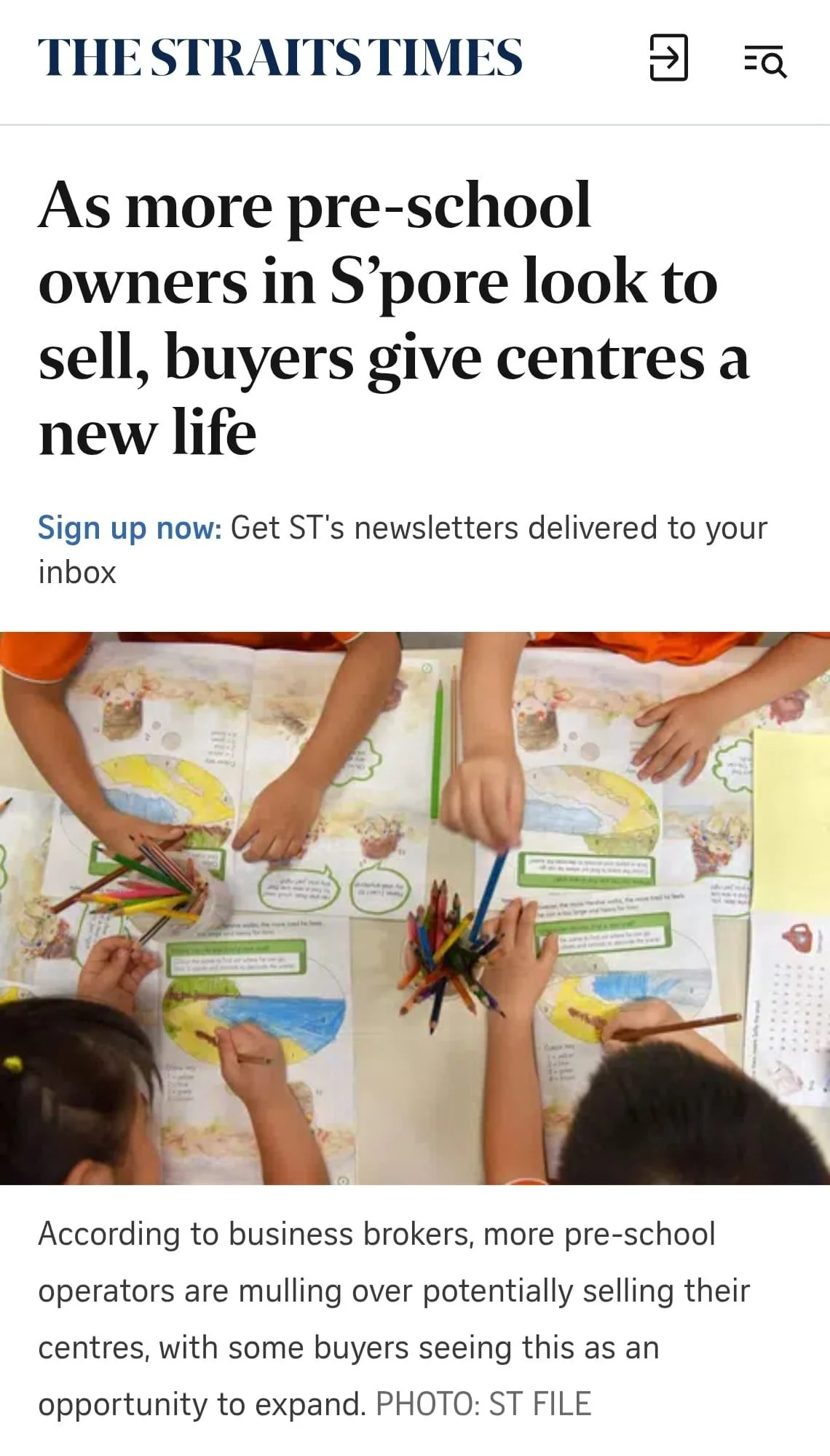
The Straits Times Article published on 27 October 2026. Featuring Wonder Yard’s co-founder, Nicole Tai, on the process of buying the pre-school.
We bought the school to keep it the same
That is the honest truth. When the previous operator announced the closure, us parents didn't rally to reinvent anything. We rallied to save the place our children ran to every morning — the child-sized interiors, the grass, the teachers, the unhurried days. The takeover was an act of preservation and nothing more.
This week, The Straits Times wrote about the quiet shift our little Wonder Yard story is part of. Owners who opened their centres in the 2000s are reaching retirement, more centres are coming up for sale, and a new generation of buyers is giving them a second life.
But it has been almost a year since we first stepped behind the curtain of a preschool. And from the inside, you see things you simply cannot see from the drop-off line. What we've seen has changed our minds. For the sake of the future generation, we cannot stay the same.
If you've been following our journey, this will sound familiar. When we wrote about why 70 preschools close in Singapore every year, and how parents saved ours, that post was about survival — the brutal maths, the families shut out by price, the teachers displaced by closures. This post is about what survival is for.
Ownership change is just paperwork. What truly matters is what happens inside the classroom. So the question we've been sitting with is this: what do you do with the freedom you've inherited?
Consistency scales, and Conviction innovates
One structural truth about the preschool industry is that big chains optimize for consistency across many centres. Whereas small schools optimize for conviction in one or few centres.
Neither is wrong, but they do produce different things.
Consistency scales — it gives every child the same experience across many locations.
Conviction innovates — it lets one school put proven research and ideas into practice quickly, while the bigger organizations are still aligning on them.
Nearly every major movement in early childhood education started this way, small and with conviction. Montessori began as a single school. Reggio Emilia as one town's practice. Neither was a hunch. Both were built on careful observation of how children actually learn (the research of their day) and they spread precisely because the results spoke for themselves.
Small schools exist because someone believed something strongly enough to stake a livelihood on it. For the children, that means an education built around a philosophy rather than a template. That means every line item a statement of belief, as we've written before. For the early childhood sector, small schools are where good research reaches real classrooms first. The findings already exist, the real gap is adoption of the practices. A preschool chain may need years to align 40 centres behind a well-evidenced method. A small school can adopt it in a term (of course, carefully, deliberately, and only because the evidence supports it). So when small schools disappear, the industry doesn't just lose diversity. It loses its fastest bridge between research and practice.
We bought a school in eight weeks. Imagine that pace applied to bringing proven research into the classroom. It isn’t fast for its own sake, but fast enough that good findings don't wait years to reach children.
Fast world, slow childhood
This is the tension we sit with every day.
Our economies, workplaces and businesses are accelerating at a pace none of us has seen before. Behaviours are shifting, and with them, our children's futures. Even the research is moving faster! Findings on how children learn are being churned out quicker than ever before, and much of it is genuinely useful.
As educators preparing children for a world we ourselves have never known, we have to be attentive. Attentive to what the evidence says, quick to understand it, and careful in how we let proven findings shape what happens in our classrooms, so that our children are future-ready by the time the future arrives.
But this is not about tearing anything down, and it is never about trying things out on children. It is about updates and tweaks, each one grounded in research; a curriculum that is alive, continuously refined against the evidence, rather than laminated.
And here's the part that cannot change: childhood itself cannot be sped up. So we hold two paces at once. Rigorous in how we think, slow in how we lead. The curriculum moves at the speed of the evidence. The children move at the speed of childhood — calm, gentle and present.
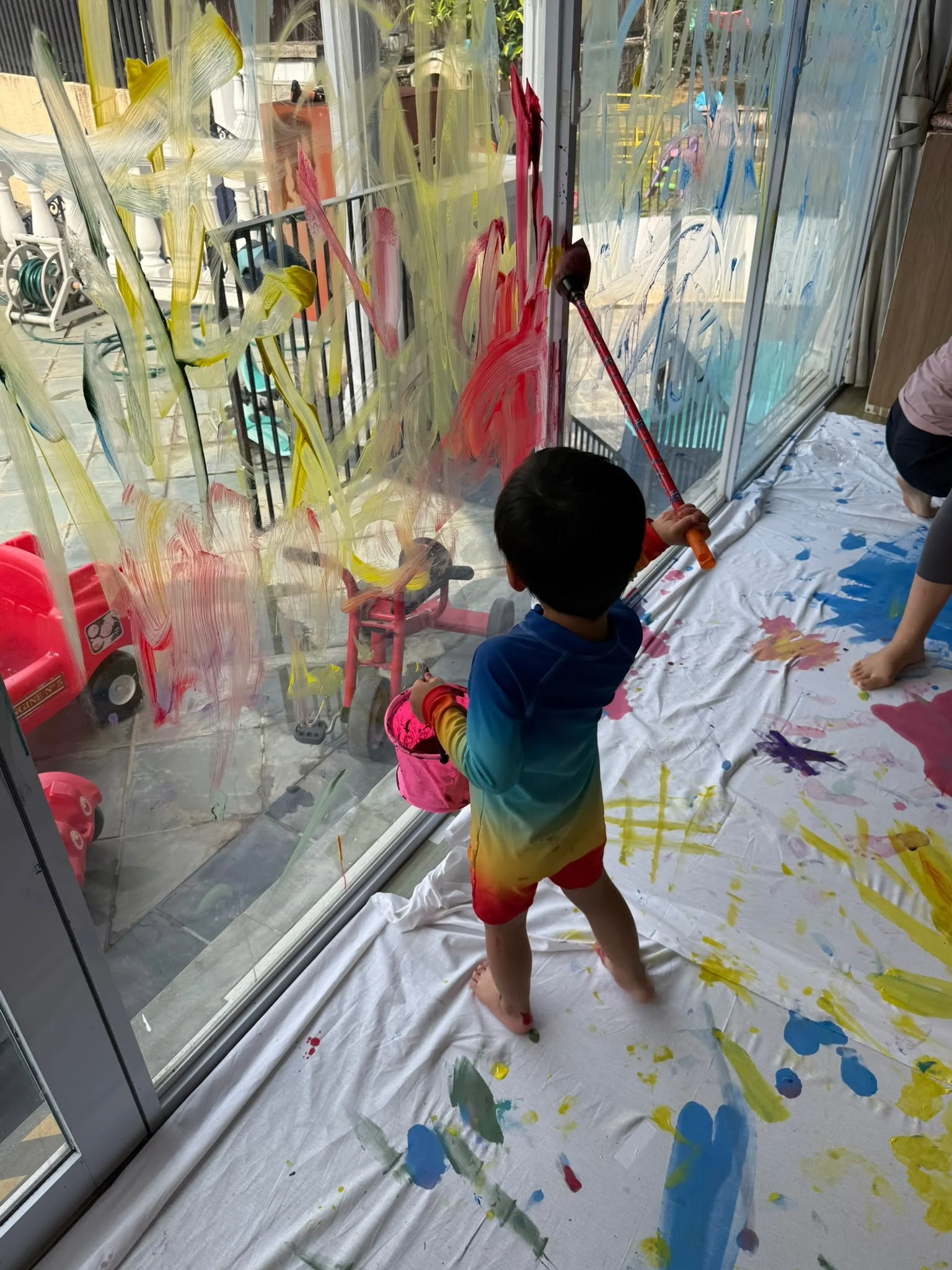
A snapshot from Wonder Yard’s children’s day messy play activity.
The fundamentals keep proving us right
Every time the world changes, the same lesson comes back around: the fundamentals matter most.
Not the trending programme nor the shiny new methods. The fundamentals are holistic development, building the whole child. Gross motor and fine motor. Emotional regulation and resilience. Joy, curiosity, and the deep safety that makes all of it possible.
None of this is new. That's rather the point. It is also, study after study, what the research keeps confirming.
Model the humanity
If anything, the age of AI has raised the stakes on the oldest parts of education.
We believe the lines between human and machine will only keep blurring. And very possibly and very soon, anything that takes effort and time, anything human made, could be a luxury. Which means our job is to model out humanity deliberately and daily. That looks like social skills, real human interaction, an understanding of self and of community, creating, craft and making things with our hands the slow way.
And underneath it all, the things no machine can hand a child: critical thinking, the preservation of cognition, a love of exploration and thought and challenge. Children who are not just comfortable with hard questions, but fond of them.
When we do it for them, we teach them they can't
We believe in trust, autonomy, and utmost respect for the little people themselves. Because when we do things for children, we teach them that they can't do it for themselves.
It is slower to let a child struggle with a zip, a puzzle, a disagreement with a friend. It is much faster, and easier on us adults, to do it for them. But the cost is a missed opportunity to practice real life skills, and the confidence that they are able. When we do it for them, we teach them that they can’t. At Wonder Yard, we choose slower every time.
Books beat algorithms
We are big on literacy. We dont mean endless worksheets and phonics drills. We mean exposure to the millions of interesting, fun, exciting things in the world, discovered through books of all kinds.
Here's why that matters more now than it ever did. The internet, social media and AI are designed to send us down rabbit holes that narrow us. The algorithm learns what you like and feeds you more of it, until your world is a corridor of your own interests.
And it goes deeper than narrowing. AI is built on big data — it can only draw from what already exists, what has already been written down, what was popular enough to be captured. That is a real ceiling, and because it is trained on the past, it carries the past's assumptions with it. Every answer arrives pre-filtered through invisible bias, and is written in a way to keep us comfortable and happy enough to continue using the AI. Whose voices were in the data, whose weren't, what got published, what got ignored. We take on that bias without ever noticing we have.
Books do the opposite. They widen. They can be weird, obscure. They sometimes present information that isn’t always the most popular. They often present information that isn’t comfortable. They hand a child unexpected information, lateral ideas, whole topics they would never have searched for. A book was chosen, written and argued over by a real human being with a point of view you can see and question. Because no big data modelled them into being recommended it. A child with a book stumbles onto new things. A child with a feed is steered away from them.
We are not anti-technology. These tools will be part of our children's lives, and understanding them matters. Which is exactly why the foundation has to be human first.
What happens next
Over the coming weeks, we'll share what all of this looks like in practice. Each element of the curriculum we're refining, and the research and reasoning behind every one of them. This post is the why, the rest of the series is the how.
We first bought this school to keep it the same. But now we're keeping it so it can become something more. Carefully, with conviction and always on the evidence.
Wonder Yard Schoolhouse is a parent-owned, play-based, bilingual preschool at 22 Li Hwan View, between Serangoon Gardens and Lorong Chuan, building on a 17-year heritage of early childhood education on this site. We are ECDA-registered, and eligible families receive Working Mother's and additional subsidies.
If this resonates, or if you're an educator who believes childhood should move at the speed of childhood, we'd love to hear from you. And if you'd like to see what an unhurried childhood looks like, book a tour on WhatsApp.
